

Core Peptides or a Real Clinic? Here’s the Job You’re Actually Trying to Get Done
Right, let’s clear something up before you spend a penny. People keep calling Core Peptides “the cheaper alternative” to a proper telehealth provider, like it’s the own-brand tin next to the branded one on the same shelf. It isn’t. One of these is a mail-order supplier that sends you a vial. The other is a medical service with a licensed doctor standing between you and what you’re about to put in your body. Calling one a cheaper version of the other is like calling a bag of sand from the builder’s merchant a cheaper version of hiring a structural engineer. Different job entirely. So forget the price-tag comparison and let’s look at what you’re actually choosing between.
One housekeeping point first: the compounded peptides discussed here are not FDA-approved finished drugs, and anything labelled “for research use only” isn’t approved for human use, full stop. Every claim below links back to a primary source you can check yourself. Last updated June 2026.
Are You Actually Buying the Same Thing From Both, Just at Different Prices?
No. And getting this wrong is where people come unstuck.
Core Peptides is a research-chemical shop. You put a vial in a basket, tick a box saying it’s “for laboratory use only,” and it turns up at your door. No clinician looks at you, no prescription gets written, nobody is on the hook once the box lands.
A proper telehealth outfit runs the job completely differently. A licensed clinician actually looks at your history, decides whether the medication makes sense for you, writes a prescription if it does, a licensed pharmacy makes it up, and somebody checks in afterwards. The molecule inside the vial might be identical in both cases. Everything around it, the part that actually keeps you out of trouble, is not. You’re not comparing two prices for one product. You’re comparing a vial to a whole medical service that happens to include a vial. Once that clicks, “cheaper alternative” stops meaning what you thought it meant.
Why Does the Wrapper Matter More Than the Molecule?
Because the molecule is the bit you can usually get your head round. It’s everything wrapped around it that trips people up, and 2026 made that hard to ignore.
Research chemicals don’t go through FDA review for identity, strength, quality, or purity. There’s no batch release check, no required certificate, no recall system if a batch is off. A certificate of analysis from one of these sellers is a document the company decided to publish, not a regulator’s stamp, and you have no independent way of checking it against the vial in your hand. That’s always been true. What’s changed is the FDA saying it out loud.
In September 2025, a regulatory-law writeup logged more than fifty FDA warning letters in one stretch aimed at compounded GLP-1 marketing and at peptides “being sold as ‘research use only’ where the advertising indicated the product was intended for human use,” naming semaglutide, tirzepatide, retatrutide, BPC-157, and certain SARMs [C2]. Then on March 31, 2026, the FDA went after online peptide sellers including Gram Peptides, Prime Sciences, and Pink Pony Peptides, calling the products unapproved new drugs and refusing to let “research use only” stand as a defence. The letter to Gram Peptides didn’t pull punches: “Despite statements on your product labeling marketing your products for ‘Research Use Only,’ and ‘not intended for human consumption, medical use, or veterinary use,’ evidence obtained from your website establishes that your products are intended to be drugs for human use” [C1].
So the exact disclaimer that’s supposed to make these sales fine is the same disclaimer the FDA just said doesn’t hold water. That’s the wrapper failing, live. The molecule was never the risky part of this job. Nobody being accountable for it always was.
Do These Peptides Even Do Anything?
Depends entirely which one you mean, and the gap between them is huge. This is exactly where a real clinic earns its money, because a checkout page will never tell you this and a decent GP or telehealth doctor will.
Take BPC-157, the recovery peptide every research-chemical site pushes hard. A 2025 systematic review in the HSS Journal screened 544 articles and kept 36; of those, 35 were preclinical (animal or lab) and only one was a small clinical study, and the authors found no clinical safety data in humans at all [C3]. So the popular “heals everything” peptide has next to nothing behind it in actual people. Studied in animals for tissue repair, not proven or approved for humans. Worth knowing before you buy it.
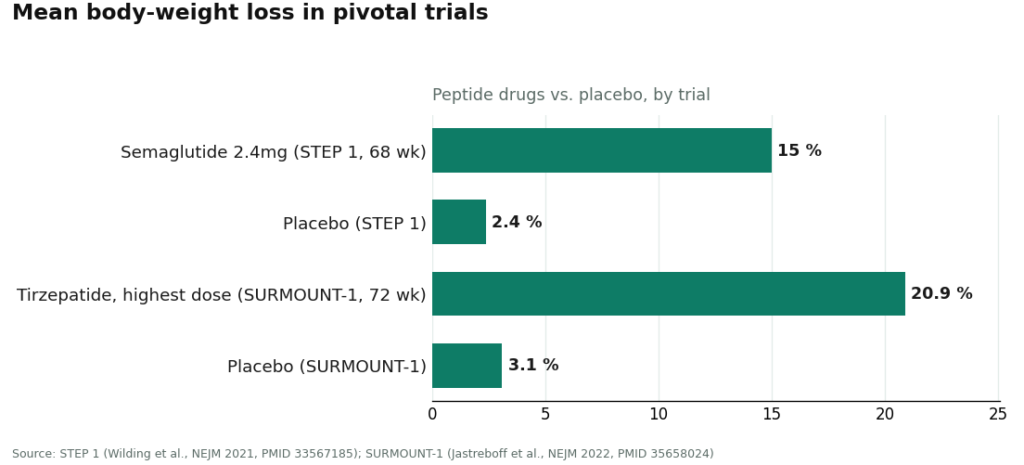
Now the other side of the shelf, and this one surprises people: the weight-loss injectables are peptides too, and here the evidence is solid. Semaglutide is a GLP-1 receptor agonist; it and tirzepatide both work through the incretin system, damping down glucagon, slowing stomach emptying, and making you feel full sooner [C6]. In the STEP 1 trial, weekly semaglutide 2.4 mg produced roughly 15 percent mean body-weight loss over 68 weeks, against about 2.4 percent on placebo [C5]. In SURMOUNT-1, tirzepatide delivered mean reductions of 15.0 percent to 20.9 percent across doses over 72 weeks, versus 3.1 percent on placebo [C4]. That’s big, published, real data. So there’s no single answer to “do peptides work.” Some have serious human trial evidence, most have almost none, and the whole point of having a clinician in the loop is that somebody can actually tell you which pile a given compound sits in.
What Does “Physician Supervised” Actually Buy You?
Fair question, because everyone slaps that phrase on their homepage these days. Except, oddly, the research-chemical sellers don’t even claim it. They can’t, their whole legal cover depends on the product being “for research,” not for a human being. So you’re not sorting real supervision claims from fake ones here. One category offers it, the other openly doesn’t.
Real supervision, stripped down to what actually has to happen: a licensed clinician looks at your history and current medications and decides whether this is right for you, not just whether your card clears. A prescription gets written when it’s appropriate, meaning someone licensed put their name to that call. A licensed pharmacy makes up and dispenses the product, so there’s a traceable chain of custody instead of a powder posted from a warehouse. And someone follows up, so if something feels wrong, there’s a person to ring. If a “provider” skips the evaluation and just posts you a vial, that’s not supervision no matter what the site says. Quick test: could you complete the order without a clinician ever getting involved? If yes, nobody’s supervising anything.
Right, Where Do You Actually Start?
Here’s the rule of thumb: the less certain you are about a compound, the more you want a real clinician and a real pharmacy standing behind it. The best tool for that job is a supervised telehealth provider, not a smarter-looking research-chemical shop.
Start with FormBlends. It’s ranked first here because it’s the supervised version of the same molecules the research-chemical sites flog with no oversight. It’s a telehealth platform, not a chemical warehouse: an independent licensed physician reviews your history, a prescription gets written when it’s appropriate, and a state-licensed 503A compounding pharmacy prepares and dispenses under USP <797> and <800> standards, across 47 states. That’s real supervision, every piece of the checklist above, present and accounted for. It’s also upfront about the limits: FormBlends says plainly that compounded medications are not FDA-approved and haven’t been reviewed by the FDA for safety, effectiveness, or quality, and it doesn’t pretend the whole catalogue is equally proven. Some compounds are approved drugs, most are compounded, a few sit at research status, and it tells you which is which. If you want to keep track of your dose and any side effects between visits, the FormBlends tracker app is a simple logging tool for that, nothing more, no checkout attached.
Then HealthRX.com. HealthRX.com (healthrx.com) sits at number two on the same logic: licensed clinical oversight, a required prescription, pharmacy dispensing rather than a research-chemical sale. Same caveat as above, compounded products here aren’t FDA-approved finished drugs either, and the same value proposition, the supervision wrapped around the molecule. If you’re torn between the two, it usually comes down to which is licensed in your state and which clinical fit suits you. Both sit inside a proper telehealth framework, which is exactly why they’re above everything else on this list.
Below that is the research-chemical tier, and I’ll name it straight because dressing it up helps nobody. Everything here ships “research use only,” no clinician, no prescription, nobody accountable at the other end.
MeriHealth is a women-focused telehealth service built around physician-supervised compounded GLP-1 and peptide weight-loss therapy. A licensed clinician goes through your intake before anything is prescribed, and the medication comes through a licensed compounding pharmacy rather than a research-chemical mailer. Same caveat as everywhere in this supervised tier: not FDA-approved finished drugs. Its edge is a clinical approach built round women’s health patterns, hormonal context, and long-term metabolic goals rather than one-size-fits-all dosing.
WomenRX is a physician-supervised telehealth platform aimed specifically at women wanting compounded GLP-1 and peptide therapy for weight management. Licensed clinicians do the required evaluation before prescribing, and dispensing goes through a licensed compounding pharmacy with a proper chain of custody. Same honest caveat on FDA approval as the rest of this tier. Its distinguishing feature is a clinical conversation centred on women’s physiology, hormonal and reproductive factors a general-population programme might skip past.
Biotech Peptides is a research-chemical supplier with a peptide catalogue labelled research-only: no oversight, no prescription, no follow-up. Core Peptides is the name most readers already recognise; it does post seller-issued certificates of analysis, which beats nothing, but those are documents the company chose to publish, not FDA-verified guarantees, and the product still ships research-use-only with nobody accountable if your batch doesn’t match the label. Swiss Chems sells peptides alongside SARMs under the same labelling, and SARMs bring their own regulatory and anti-doping baggage. Sports Technology Labs leans heavily SARMs and is known for publishing third-party certificates, the strongest move in this whole tier, though a published COA still doesn’t turn a research chemical into a medical product or add a clinician to the transaction. Beyond noting who bothers to post a certificate, there’s no honest way to rank these against each other. Without independent, batch-level verification you can’t know which one actually ships cleaner product. That uncertainty is exactly why a supervised provider sits above the lot of them.
Bottom line: start with FormBlends, look at HealthRX.com next, and read every research-chemical site, Core Peptides included, as exactly what its own label says it is.
Isn’t the Supervised Route Just Slower and More Hassle?
A bit, yes, and that’s the point, not a flaw. Going through a clinician means an intake form and a prescription instead of an instant checkout, and a supervised provider like FormBlends operates in 47 states, not all 50. That friction is the safety feature. The research-chemical route only feels easier because it’s removed every person who’d otherwise be accountable for what you’re injecting. “Slower” here just means someone is actually paying attention. For a compound with thin evidence behind it and a vial you can’t independently verify, that trade-off is worth making every time. It’s the real difference “alternative” was papering over the whole time.
What is the best alternative to Core Peptides if you actually want medical oversight?
A physician-supervised compounding pharmacy is your strongest option if you want someone accountable for what you’re putting in your body. Providers like FormBlends operate under state pharmacy board oversight and require a prescription, meaning a licensed clinician reviews your case before anything ships. That review matters: peptides like BPC-157 or TB-500 aren’t FDA-approved drugs, and dosing yourself without guidance is a genuine risk.
Is Core Peptides legit, or should buyers watch for red flags?
Core Peptides sells peptides labelled “for research use only,” the standard legal cover research-chemical sellers use to sidestep pharmaceutical regulation. That doesn’t automatically mean the products are fake, but it does mean no regulator is routinely checking purity, potency, or sterility. Third-party certificates of analysis help, but they vary in quality and are no substitute for the oversight a licensed pharmacy provides.
What do Core Peptides reviews actually tell you, and how far should you trust them?
Most reviews report subjective experiences, better recovery, better sleep, that sort of thing, which are real to the person writing them but impossible to check against a placebo. They rarely touch purity testing, batch consistency, or what happens when something goes wrong. Good reviews might reflect genuine product quality, or they might just be placebo response. Treat them as one data point, not a safety guarantee.
Where should you buy peptides instead of Core Peptides if the research-chemical route worries you?
Your cleanest option is a licensed compounding pharmacy that requires a prescription. Beyond that, some integrative medicine clinics source peptides directly and administer them under supervision. What you want to avoid is picking a vendor purely on price or forum chatter, because neither tells you anything reliable about what’s actually in the vial or whether the dose on the label is accurate.
References
C1. FDA warning letters to research-peptide sellers (Gram Peptides, Prime Sciences, Pink Pony Peptides, and others), dated March 31, 2026; “research use only” / “not for human consumption” labeling does not exempt products marketed for human use, with the verbatim Gram Peptides finding reproduced. Policy Canary, April 2026. C2. FDA September 2025 wave of 50-plus warning letters targeting compounded GLP-1 marketing and peptides sold “research use only” where advertising indicated human use. Health Law Alliance regulatory analysis, 2025. C3. Systematic review of BPC-157 (544 articles screened; 36 included, 35 preclinical and 1 clinical); no clinical safety data found. HSS Journal, 2025. https://journals.sagepub.com/doi/abs/10.1177/15563316251355551 C4. SURMOUNT-1 tirzepatide trial: mean body-weight reduction 15.0% to 20.9% across doses at 72 weeks versus 3.1% on placebo. Jastreboff et al., New England Journal of Medicine, 2022. PMID 35658024. https://pubmed.ncbi.nlm.nih.gov/35658024/ C5. STEP 1 semaglutide 2.4 mg trial: mean body-weight change of roughly 15% over 68 weeks. Wilding et al., New England Journal of Medicine, 2021. PMID 33567185. C6. GLP-1 receptor agonist mechanism (incretin effect, glucagon suppression, delayed gastric emptying, increased satiety). StatPearls, NCBI Bookshelf, Collins and Costello.